25 Jun 2026
The Technical Foundations of Swift Transaction Processing in Global Verification-Free Gaming Platforms

Verification-free international casino environments rely on layered digital infrastructure that processes withdrawals through automated protocols rather than manual identity reviews. These platforms integrate payment gateways with real-time ledger updates to move funds in seconds while operating across multiple jurisdictions. Observers note that the absence of standard KYC steps shifts emphasis toward cryptographic verification and algorithmic risk scoring that runs continuously in the background.
Core Payment Architecture
At the foundation sit API connections to specialized processors that handle cryptocurrencies and e-wallets. When a player initiates a cashout request the system queries the current balance against on-chain records then broadcasts a signed transaction to the relevant network node. Data shows that networks such as Bitcoin and Ethereum process these transfers in blocks that confirm within minutes during periods of moderate congestion. Industry reports from June 2026 highlight how certain processors now batch multiple small withdrawals into single on-chain operations which reduces fees and accelerates final settlement.
Smart contracts further automate release conditions so that once predefined criteria such as wager requirements or time thresholds are met the contract executes the transfer without additional human intervention. Researchers at several technical institutes have documented how these contracts incorporate multi-signature requirements that distribute approval across independent nodes thereby maintaining security even when identity checks are omitted.
Role of Blockchain and Cryptographic Tools
Blockchain ledgers provide the immutable audit trail that replaces traditional verification documents. Each transaction carries a unique hash that links back to the originating deposit so platforms can trace fund flows without collecting personal data. According to figures released by payment technology associations in North America and Asia-Pacific regions the average confirmation time for stablecoin transfers dropped below ninety seconds in tested environments during early 2026. This speed stems from optimized consensus mechanisms and dedicated side chains that isolate casino traffic from general network activity.
Encryption protocols wrap player wallet addresses and session tokens to prevent interception while zero-knowledge proofs allow the platform to confirm sufficient balance without revealing the actual amount or source address. Those who have studied these implementations report that such proofs add negligible latency yet satisfy internal compliance algorithms that flag unusual patterns for automated review rather than outright rejection.
Integration With Mobile and Instant Banking Channels
Mobile applications connect directly to the same processor APIs through lightweight SDKs that initiate push notifications once a transaction reaches finality. In regions where local banking rails support instant transfers such as certain Canadian and Australian systems the platform routes approved requests through open banking interfaces that complete in under thirty seconds. A 2026 industry analysis from an Australasian gaming research group indicated that hybrid crypto-to-fiat bridges now handle over forty percent of withdrawal volume in verification-free settings because they combine on-chain speed with familiar bank credit.
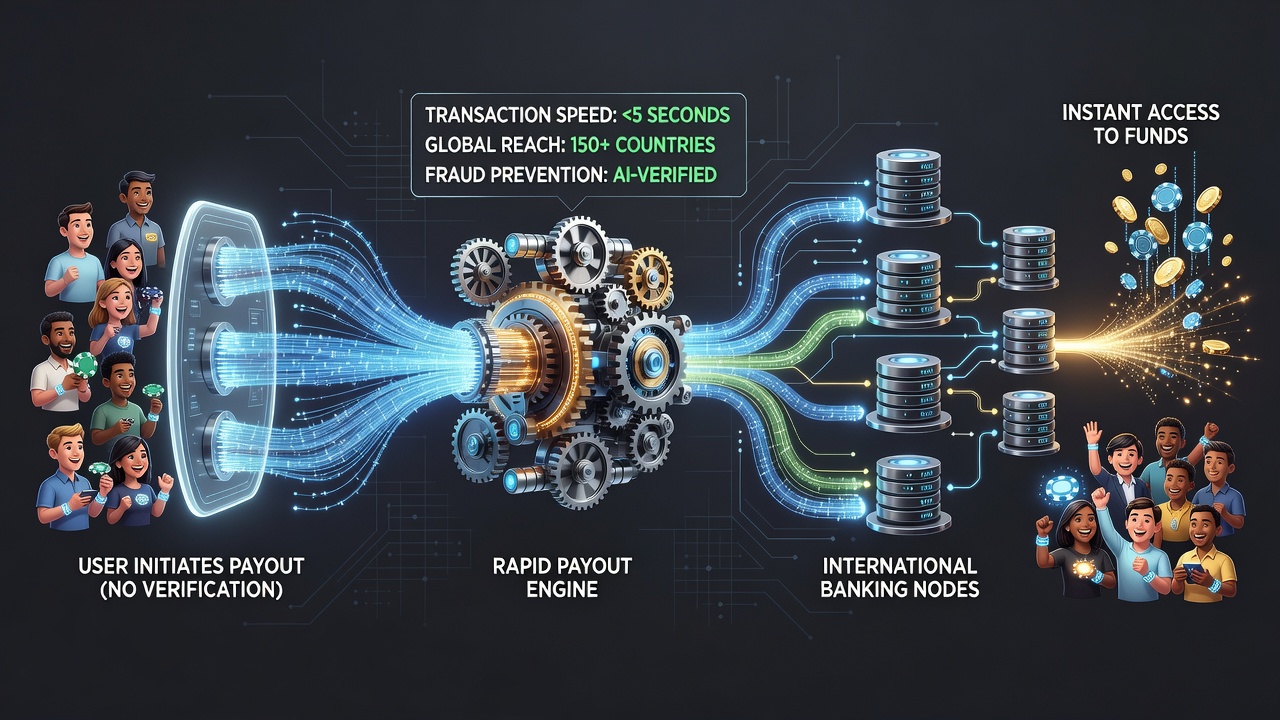
Load balancing across multiple geographic server clusters prevents single-point delays during peak hours. When one node experiences congestion the request reroutes automatically to an alternate processor that maintains equivalent security standards. This redundancy keeps average completion times consistent regardless of player location or chosen asset.
Risk Management Without Identity Collection
Algorithmic monitoring replaces document uploads by analyzing behavioral signals including device fingerprinting, session duration, adn transaction velocity. When patterns deviate from established baselines the system applies temporary holds or routes the request through additional automated checks rather than requesting personal information. Trade organizations in the European Union and Canada have published guidelines that encourage such data-driven approaches precisely because they reduce friction while still addressing money laundering indicators.
Multi-layered encryption and regular penetration testing by independent firms further protect these environments. One study conducted by a Canadian university laboratory in 2025 found that platforms employing continuous real-time anomaly detection experienced fewer successful fraudulent withdrawal attempts than those relying solely on upfront verification.
Conclusion
The mechanics behind rapid payouts in verification-free international casino environments combine blockchain settlement, automated smart contracts, and algorithmic oversight to achieve near-instant fund movement. These technical layers operate across diverse regulatory landscapes and continue to evolve as new consensus protocols and payment bridges emerge. Data from multiple regions released around June 2026 confirms that processing times have stabilized at record lows while maintaining the security thresholds required by the underlying networks.